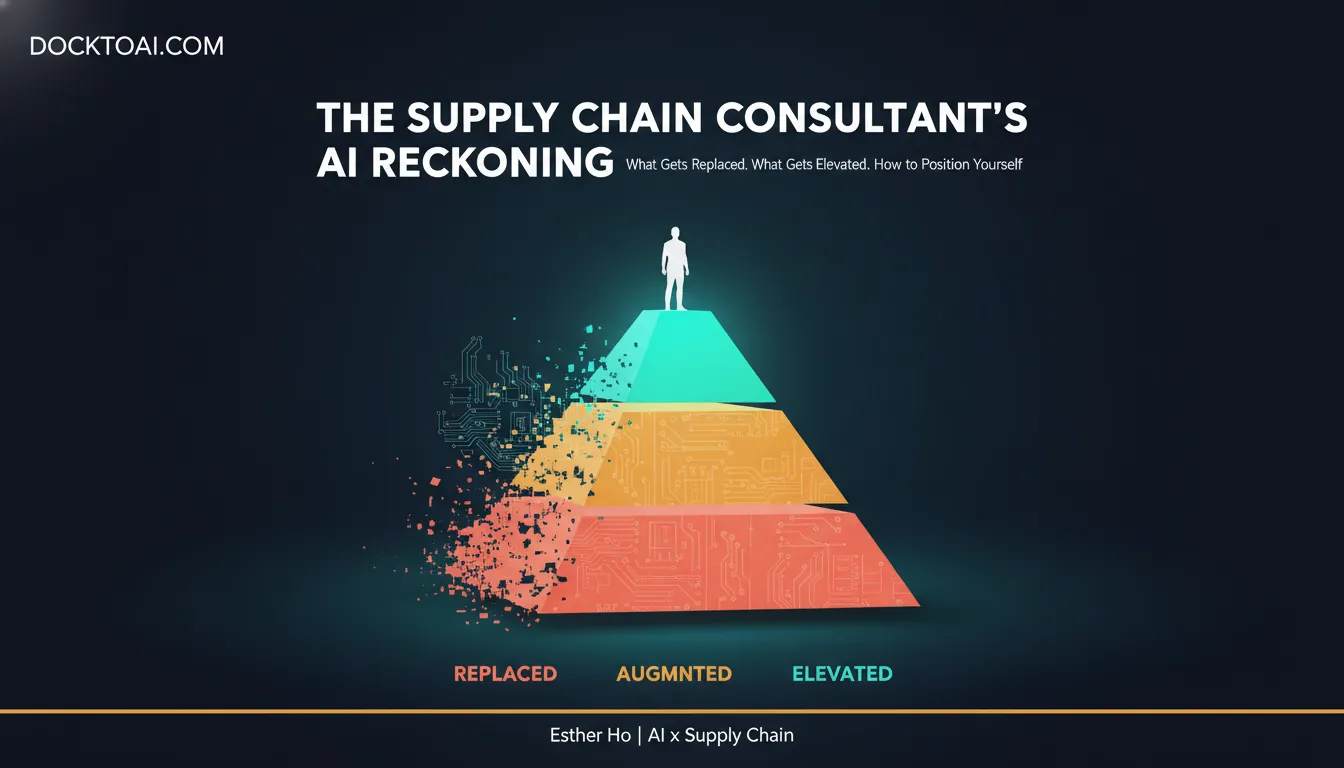
The Supply Chain Consultant's AI Reckoning: What Gets Replaced, What Gets Elevated, and How to Position Yourself
The top consulting firms have collectively poured over $10 billion into AI since 2023. One major firm now runs 25,000 AI agents alongside its human workforce and expects 1:1 parity by year-end. A landmark Harvard Business School study found that consultants using AI completed 12% more tasks, 25% faster, with over 40% higher quality.
Those numbers stopped me when I first read them. Not because it's surprising that consulting is investing in AI. Everyone knows that. What stopped me is what it implies for people like me: supply chain practitioners who built careers on the skills AI is now doing faster, cheaper, and at scale.
I spent 15 years in supply chain consulting across four continents. I've built demand planning models in Excel. I've formatted thousands of PowerPoint slides at 2am before a client presentation. I've cleaned data sets that should have been cleaned years before anyone hired a consultant to look at them.
Every one of those tasks is now being automated. The question isn't whether the consulting model is changing. It's whether the people inside it are changing fast enough.
The Skills AI Is Already Replacing
Let me be specific about what's being automated, because vague warnings about "AI disruption" don't help anyone.
Data analysis and reporting. This was historically the bulk of billed hours in supply chain consulting. Collecting data, cleaning it, running analyses, generating reports. A Harvard Business School study with 758 consultants found that AI users completed 12.2% more tasks, 25.1% faster, with over 40% higher quality. Tools like Datup now deliver 95%+ demand forecast accuracy. Microsoft's IQ Suite handles everything from demand planning to customer service reporting as an integrated intelligence layer. A supply chain consultant who bills primarily for data analysis is competing against software that doesn't sleep, doesn't make copy-paste errors, and doesn't charge by the hour.
Presentation creation. The average business presentation took 4.2 hours to create in 2023. In 2026, it takes 38 minutes. AI tools generate a 12-slide deck in 22 seconds. The AI presentation market hit $4.7 billion with 62% enterprise adoption, and consulting leads at over 75%.
PowerPoint isn't dead. It's still the mandated export format for most enterprise clients. What died is the value of being good at making slides. A consultant who can frame a sharper recommendation in 38 minutes beats one who spends 4 hours making prettier ones. The competitive differentiator shifted from production quality to strategic insight quality.
Market sizing and competitive analysis. What used to take a junior analyst a week of research, a senior consultant can now do in an afternoon with AI-assisted web research, data synthesis, and report generation. The pattern across major firms is consistent: client-facing roles are growing while non-client-facing roles (the research and analysis layer) are shrinking. One firm reported a 25% reduction in back-office headcount while output from that side grew 10%.
Inventory optimization and demand forecasting. This is where it gets personal for supply chain consultants. Multi-agent reinforcement learning systems are achieving 6-16% improvement over traditional heuristics in multi-echelon inventory networks. AI planning engines continuously recalculate optimal stock levels. Route optimization happens in real time instead of quarterly reviews. The tools that supply chain consultants used to recommend and implement are now doing the consulting themselves.
The Uncomfortable Middle
BCG's 2026 supply chain planning report contains a finding that should worry every consultant who thinks technology adoption alone is the answer: only 1 in 5 organizations reports meaningful value from advanced AI capabilities. Organizations taking a technology-first approach see single-digit productivity improvements. The ones hitting 50%+ gains share three characteristics: integrated data foundations, process redesign, and planner upskilling.
This is the gap consultants should be living in. But most aren't.
Here's the uncomfortable truth. Gartner predicts that through 2026, 50% of global organizations will require "AI-free" skills assessments because critical thinking skills are atrophying from GenAI use. AI doesn't just replace skills. It erodes the ones it augments. If you outsource your analytical thinking to AI for two years, what happens when the AI gets a supply chain scenario wrong and you can't spot it? That's the real risk for consultants: losing the judgment that made you worth hiring in the first place.
What AI Cannot Replace (Yet)
After working on transformation projects across the US, China, Germany, and Latin America, I can tell you that the skills that mattered most were never the ones you could bill by the hour.
Contextual judgment. Knowing when the AI is wrong because you've seen what happens when a container gets stuck in customs in Shenzhen for three weeks. No model has that scar tissue.
Problem framing. The most valuable thing a consultant does is define the right question. AI can answer questions at scale. It cannot figure out which question the client actually needs answered.
Exception management. BCG found that planners in leading organizations are becoming "exception managers and strategic decision-makers," focusing on the 5% of situations AI cannot handle. That 5% is where careers are built.
Stakeholder communication and change management. Getting a supply chain transformation adopted by a 50,000-person organization has almost nothing to do with the quality of the algorithm. It has everything to do with the person presenting it, their credibility, their political awareness, their ability to translate technical outputs into language that a CFO will act on.
Supplier relationship management. Trust, negotiation, partnership building. These are human skills that become more, not less, valuable as AI handles the transactional work.
The Transformation Path
I've been thinking about this for myself, not just as an abstract industry trend. Here's how I see the career evolution for supply chain consultants.
Phase 1: AI-augmented (where most people are now). You use AI tools to do your existing job faster. You still think of yourself as a consultant who happens to use AI. You're more productive, but your value proposition hasn't changed.
Phase 2: AI-native (where you need to be). You redesign your work around AI capabilities. You don't optimize the old process with AI. You build new processes that are only possible because AI exists. You can orchestrate multiple AI tools, know which model to use for which problem, and can evaluate when the output is wrong.
Phase 3: AI-strategic (the real opportunity). You help organizations build the systems, governance, and culture for AI-native supply chains. Not implementing a tool, but architecting how humans and AI agents work together. This is where the new roles are: Digital Twin Architect, Agentic Procurement Engineer, AI Forecast Coach, Supply Chain Agent Manager.
AI-related supply chain job postings grew 86% from December 2022 to December 2024. Workers with AI skills earn 25-30% more than peers in identical roles. Gartner forecasts 1 in 5 procurement professionals will occupy entirely new AI-driven roles by 2030.
The market is telling you where to go. The question is whether you're moving.
What I'm Doing About It
I'm not writing this from a theoretical perch. I'm in the middle of this transition myself.
I built an AI-powered research pipeline that generates daily digests on AI and supply chain trends, synthesized from dozens of sources, delivered to my inbox every morning. I use a personal knowledge base that maps connections between academic papers, industry reports, and my own content using a knowledge graph tool called Graphify.
I'm learning to build AI agent workflows, not just use them. The difference matters. A consultant who can use ChatGPT is table stakes. A consultant who can architect a multi-agent system for autonomous procurement, build the harness that keeps it accountable, and explain the ROI to a skeptical COO? That's a different conversation entirely.
The skills that got me here (Excel modeling, PowerPoint slides, data analysis reports) were valuable because they were hard to do well. They're not hard anymore. The new hard thing is knowing what to do with the AI's output, when to trust it, when to override it, and how to build systems where humans and agents collaborate without either side becoming a bottleneck.
The Bottom Line
Goldman Sachs reports that employees save 40-60 minutes per day with AI, but 80% of companies aren't using it yet. Gartner predicts 20% of organizations will use AI to flatten their org structures, eliminating 50%+ of middle management positions through 2026.
The consulting pyramid is being compressed. The bottom (research, analysis, formatting) is being automated. The middle (project management, basic strategy) is being augmented. The top (client relationships, strategic judgment, change leadership) is becoming more valuable.
If you're a supply chain consultant reading this, here's my honest advice: don't wait for your firm to retrain you. The firms that invested early ($10B+ collective AI spend since 2023, entire divisions built around agentic AI) are building the future around people who are already moving.
Start with one AI tool and go deep. Build something, don't just use something. Understand the architecture, not just the interface. And spend time on the skills AI cannot do: framing problems, reading rooms, building trust, making judgment calls under uncertainty.
The supply chain consultants who thrive in 2026 and beyond won't be the ones who avoided AI. They'll be the ones who figured out what only humans can do, and got very good at it.
The AI can build the model. Can you ask the right question?