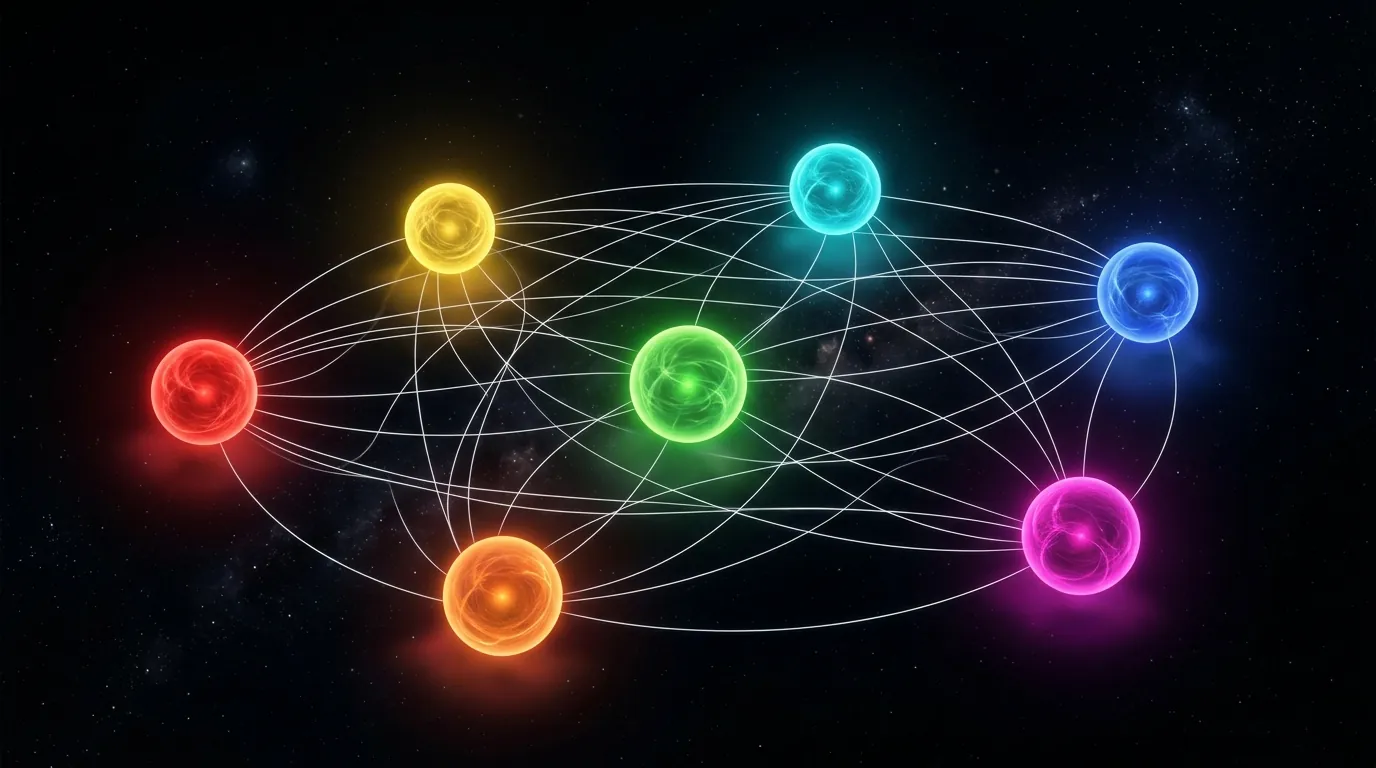
Why Solo AI Agents Are Dead. The 1,445% Surge in Multi-Agent Systems, Explained.
Gartner documented a 1,445% surge in multi-agent system inquiries from Q1 2024 to Q2 2025. That's not a typo. Enterprise interest in orchestrated AI agent teams grew nearly 15x in fifteen months.
The question is no longer whether to deploy AI agents. It's whether to deploy one agent or many. And the data is increasingly clear: for complex workflows, the answer is many.
Enterprises deploying multi-agent architectures report 3x faster task completion and 60% better accuracy on complex workflows compared to single-agent implementations. In incident response trials, multi-agent orchestration achieved a 100% actionable recommendation rate versus 1.7% for single-agent approaches.
But there's a catch. And if you've lived through the microservices revolution in software architecture, you already know what it is.
The Microservices Analogy (and Why It Matters)
If you were building software in 2015, you watched the industry shift from monolithic applications to microservices. One massive codebase became dozens of small, specialized services that communicated through APIs.
The same thing is happening with AI agents right now. One massive, general-purpose agent is being replaced by teams of specialized agents that collaborate through orchestration protocols.
The parallel is precise. A monolithic agent tries to do everything: classify intent, retrieve knowledge, generate responses, check quality, handle escalations. It's brittle, hard to scale, and difficult to debug. A multi-agent system breaks these into separate specialists, each excellent at one thing, coordinated by an orchestrator.
In supply chain, this is a pattern I've seen work exceptionally well. Instead of one agent trying to handle the entire order-to-delivery workflow, you deploy separate agents for demand forecasting, inventory optimization, route planning, exception management, and customer communication. Each agent has a narrow scope, deep specialization, and clear interfaces with the others.
But here's where the microservices analogy also serves as a warning.
The Warning the Microservices Era Taught Us
The microservices revolution followed a predictable arc: monolith, then decomposition euphoria, then "oh no, distributed systems are hard," then finally settling on practical boundaries.
Multi-agent systems are following the same curve. And the failure modes are remarkably similar.
The "bag of agents" anti-pattern. Towards Data Science documented that poorly designed multi-agent systems can produce 17x more errors than properly orchestrated ones. The term "bag of agents" refers to throwing multiple agents together without structured topology or clear coordination. It's the AI equivalent of building microservices without an API gateway.
Latency compounds differently. Microservices deal in milliseconds of network latency. Agents deal in seconds of inference time. Ten agent hops can turn a trivial request into a 30-second wait. If your customer service system requires five agents to process a simple query, you've built something slower than a human.
The distributed monolith. Some teams rush to split everything into eight specialized agents when a single agent with good tool selection handles 90% of use cases. Princeton's NLP group found that single-agent systems matched or outperformed multi-agent systems on 64% of benchmarked tasks when given the same tools and context.
The biggest lesson from the microservices era: don't decompose too early.
When Multi-Agent Actually Wins
So when should you use multiple agents? Microsoft's Cloud Adoption Framework provides a clear decision framework.
Use multi-agent when:
You're crossing security or compliance boundaries. Regulations mandate strict data isolation, like separation of duties in financial services. Multi-agent lets you enforce boundaries at the architectural level.
Multiple teams are involved. Distinct teams manage separate knowledge areas, and independent development cycles benefit from decoupled architectures. This is the same reason microservices work well for large organizations with multiple autonomous teams.
Your solution roadmap spans three to five or more distinct functions. If you're building something that will grow to cover demand planning, procurement, logistics, and customer service, designing for multi-agent from the start makes sense.
Stick with single-agent when:
You need speed to market. Coordination overhead between agents is real. A single well-equipped agent ships faster.
Cost is a priority. Each agent processes context tokens. Multiple agents multiply your API costs. For budget-constrained deployments, one agent is dramatically cheaper.
The task doesn't require parallel execution or multi-domain specialization. Most customer support queries, most data analysis tasks, most code generation tasks work fine with a single capable agent.
The Four Orchestration Patterns
The industry has converged on four primary patterns for coordinating multi-agent systems.
Sequential. Agents execute in a fixed order. Agent A completes, passes state to Agent B. Best for structured business processes like document approval pipelines or regulatory reporting workflows.
Parallel. A lead agent decomposes work and dispatches sub-agents simultaneously. Anthropic's internal research architecture uses this pattern, with sub-agents gathering data in parallel, outperforming single-agent benchmarks by 90.2%.
Supervisor (hub-and-spoke). A central manager agent routes tasks to specialist workers and synthesizes results. This is the most common production pattern I see in supply chain applications. A planning orchestrator coordinates demand, inventory, and logistics agents.
Hierarchical. Higher-level agents supervise teams of lower-level agents. Higher levels focus on coordination and planning, lower levels on execution. Microsoft's healthcare implementations use this with a central orchestrator managing patient flow while specialized agents handle clinical tasks autonomously.
Most successful production systems use hybrid approaches. A hierarchical structure at the top level with parallel execution within each team.
Governance-as-Code: The Missing Piece
Here's what separates multi-agent systems that work from ones that fail: governance.
Governance-as-code means translating organizational rules, regulatory requirements, and operational controls into machine-readable policies that are enforced automatically at runtime. Not through manual review. Not through hope.
Microsoft released the Agent Governance Toolkit as open source on April 2, 2026, addressing all 10 OWASP agentic AI risks with deterministic, sub-millisecond policy enforcement. IBM and e& announced a strategic collaboration to build enterprise-grade agentic AI foundations with embedded governance.
The regulatory pressure is real. The EU AI Act's high-risk obligations take effect August 2026. Only 6% of organizations currently have advanced AI security strategies, despite 40% of enterprise apps expected to embed agents by year end.
KPMG found that 75% of leading teams prioritize security, compliance, and auditability as the most critical requirements for agent deployment. Governance isn't a nice-to-have. It's the thing that determines whether your multi-agent system makes it to production.
Real Deployments in the Field
The theory is interesting. The practice is what matters.
Walmart deployed a "Trend-to-Product" multi-agent engine that tracks social media trends, generates product concepts, and feeds them into prototyping and sourcing. They also unified their supply chain with agentic AI for real-time inventory visibility across stores, fulfillment centers, and logistics.
UiPath and Deloitte launched "Agentic ERP" in March 2026, coordinating AI agents, robots, enterprise systems, and people across Record-to-Report, Source-to-Pay, and Lead-to-Cash workflows.
Getronics automated over 1 million IT tickets annually using a multi-agent platform. PagerDuty built agentic triage that queries monitoring tools, correlates logs, identifies causes, and executes remediation playbooks.
The MarketsandMarkets AI Agents report projects the multi-agent systems segment specifically at 48.5% CAGR, faster than the overall AI agent market's 46.3%. The market is voting with dollars.
My Take
Here's what I think is actually happening.
Multi-agent systems are not a silver bullet. They're an architectural pattern that works well for specific types of problems: complex, multi-domain workflows that benefit from specialization and parallel execution. For everything else, a single well-configured agent is simpler, cheaper, and faster.
The companies that will win are the ones that match the architecture to the problem. Not the ones that build the most sophisticated multi-agent system. Not the ones that stick with a single agent because it's easier.
If your workflow crosses organizational boundaries, requires specialized domain knowledge in multiple areas, and benefits from parallel processing, build for multi-agent. If it doesn't, don't add complexity you don't need.
Three similar lines of code are better than a premature abstraction. Three similar agents coordinated by an orchestrator might be worse than one agent with three tools.
Start simple. Scale when the data tells you to. That's how you avoid becoming the next cautionary tale.
Follow Me
If this was useful, follow me on X @docktoai for more on AI, supply chain, and making operations actually work.
I also share insights on LinkedIn.