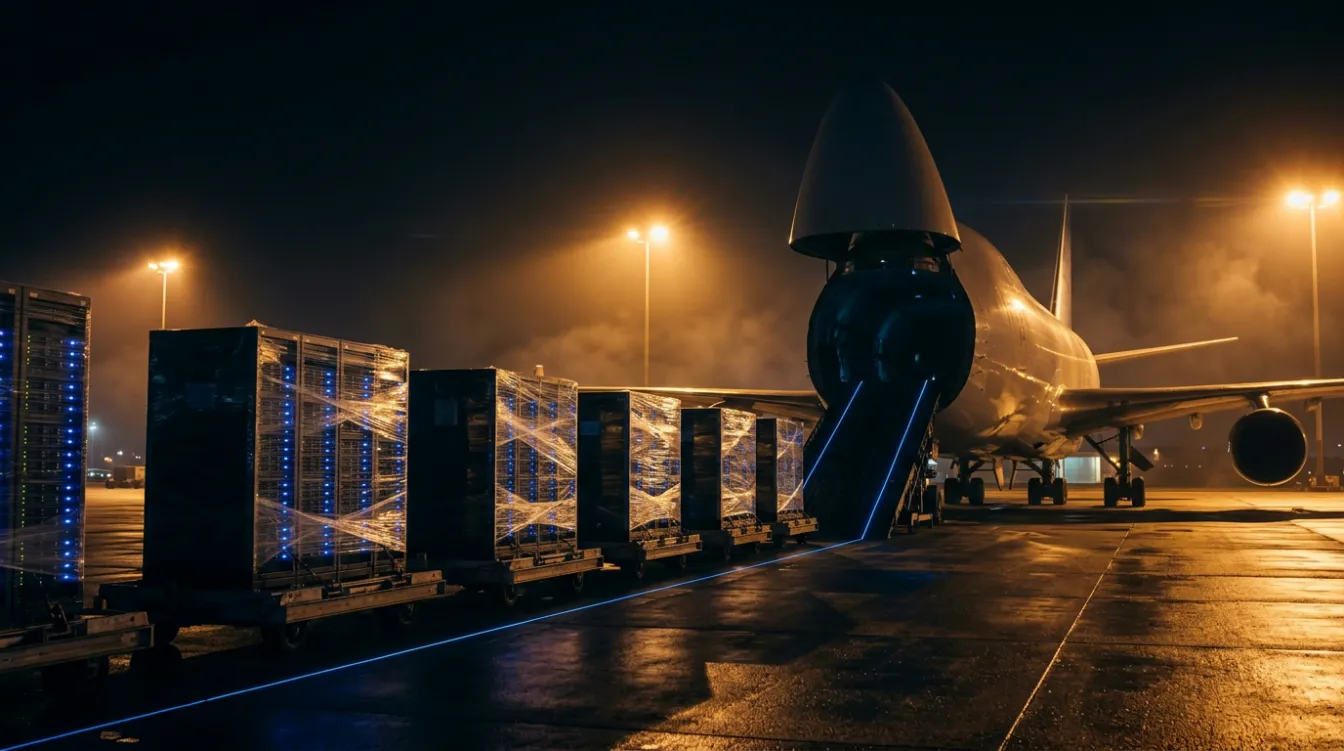
Most people still talk about AI as if it lives in software.
Models. Tokens. Benchmarks. Agents. Interfaces.
But the AI boom is also becoming a physical freight story.
I do not see this only as a headline.
I started working in the FedEx system in 2006, across FedEx Global Trade and FedEx Express, where I had firsthand exposure to semiconductor and hardware logistics. Later, through my own company, I worked with different 3PLs and carriers in the US and globally.
I mention that not as a credential line, but because it shaped how I read this market.
Over the past 15-plus years, I have watched freight operating logic change from the inside: how capacity gets allocated, how urgent cargo gets protected, how trade requirements change routing decisions, how hardware customers think about lead time, and how consumer-goods teams feel the impact when the network tightens. Those experiences trained me to look at AI infrastructure not only as a technology trend, but as a new physical demand pattern entering the freight system.
So when I see AI hardware demand showing up in freight reports, I read it differently.
I do not read it as "AI is hot."
I read it as a new demand pattern entering an operating system I have watched change for nearly two decades.
That is also why I keep coming back to one conclusion: the AI supply chain is still young.
Not young because the companies are small. They are not.
Young because the operating model around AI infrastructure is still being built while the demand is already moving. The sourcing logic, freight allocation, installation cadence, service promises, and contingency playbooks are still catching up to the physical reality of AI build-out.
Chips need to move. Servers need to move. Racks, boards, cooling systems, networking equipment, power components, and data-center hardware need to move. They do not teleport from a model release note into a data center. They move through airports, ocean lanes, ports, cross-docks, warehouses, and final installation schedules.
That matters because AI infrastructure is not just another commodity category. It is high value, time sensitive, and backed by buyers with urgent deployment timelines. When that demand enters a constrained freight market, it changes the operating question for everyone else using the same network.
For consumer-goods shippers, the question becomes: what happens when the freight market has a new priority customer with deeper pockets and less tolerance for delay?
For freight carriers and forwarders, the question becomes: what happens when AI infrastructure becomes a recurring capacity segment, not a one-off project cargo spike?
The answer is not that AI will swallow all freight capacity. That would be too broad.
The sharper point is this: AI is becoming a freight customer, and freight strategy has to start treating it like one.
The Signal From Taiwan
Dimerco's July 2026 Asia Pacific Freight Report gives a clean example.
The report says strong AI and semiconductor demand from Taiwan to the US has left the Taipei transit hub fully loaded, keeping outbound capacity tight and rates firm across US and regional lanes. Dimerco's summary is blunt: AI-driven volumes have filled the TPE hub to capacity, and until that demand eases, space and rates across US and regional lanes remain under pressure.
STAT Times' coverage of the same Dimerco report adds the operating detail: Taiwan remains a major consolidation point for US-bound high-tech cargo, airfreight space is scarce, and rates remain firm on both US and regional routes.
This is the kind of signal supply-chain teams should pay attention to.
Not because one hub defines the whole market.
Because it shows how AI demand enters the freight system. It does not appear as an abstract tech trend. It appears as high-value cargo competing for uplift, routing priority, terminal space, and booking windows.
And that pressure does not stay neatly inside the tech industry.
If you move consumer electronics, apparel, seasonal retail, beauty, health products, specialty parts, or promotional inventory through the same origins and transshipment points, you are exposed to the same capacity environment. Even if your cargo has nothing to do with AI, your shipment can still be priced and routed in a market shaped partly by AI hardware.
That is the first management shift.
AI demand may not be your category, but it can still become your lane condition.
That is also why the Dimerco signal stands out to me. I do not need to overstate my connection to any one provider for this point to matter. When you have watched express freight, global trade, 3PL and carrier networks, and semiconductor or hardware logistics evolve over many cycles, you learn that "capacity is tight" is never just a market phrase. It means someone is deciding which shipment gets protected space, which customer gets a hard conversation, which route gets changed, and which promise has to be renegotiated.
Ocean Freight Is Sending The Same Warning
Air is the obvious place to see AI hardware pressure because high-value electronics often justify premium transport.
But the broader market context matters too.
Dimerco's July report says stronger-than-expected US import demand is keeping transpacific space tight and rates firm through peak season, and it advises pre-booking three to four weeks ahead. It also flags blank sailings and congestion at transshipment hubs such as Singapore and Port Klang as factors tightening effective capacity.
FreightWaves reported on July 2 that Asia-US West Coast prices rose to $6,175 per FEU and East Coast prices rose to $7,998 per FEU, citing Freightos data. The article frames the move as driven more by peak-season demand than by oil prices.
C.H. Robinson's July ocean update makes the planning implication more useful: July ocean freight is not one synchronized market. Some lanes are tight because of demand and cargo pull-forward. Others are constrained by service withdrawals, blank sailings, port omissions, or container shortages. The practical advice is to identify the specific constraint before cargo is ready, then match booking, routing, and equipment planning to that risk.
That is exactly where the AI freight-customer thesis matters.
Consumer-goods shippers are used to planning around seasonal retail demand, weather, labor disruption, tariffs, blank sailings, port congestion, and geopolitical risk. Now add a new layer: AI infrastructure demand that can show up in the same high-value air lanes, the same Asian export hubs, the same premium service conversations, and the same equipment-allocation decisions.
This does not mean every consumer-goods shipment gets displaced by a server rack.
It means the old category boundaries are less useful.
A consumer-goods shipper may think it competes with other consumer brands for capacity. A carrier may think in verticals: retail, automotive, healthcare, industrial, technology. But lane pressure is not organized by marketing category. It is organized by cargo characteristics, timing, value density, routing needs, and willingness to pay.
AI infrastructure scores high on several of those dimensions.
That changes the room.
What This Means For Freight Carriers
For freight carriers, forwarders, and 3PLs, AI infrastructure is not simply "more volume."
It is a different kind of demand signal.
AI-related hardware tends to be high value, time sensitive, technically complex, and connected to deployment schedules that may have executive visibility. The cargo can require careful handling, stronger chain-of-custody expectations, security controls, temperature or moisture considerations, installation coordination, and more precise milestone reporting.
That creates three carrier implications.
First, allocation strategy gets more complicated.
If AI infrastructure demand keeps appearing on certain lanes, carriers will need to decide whether it deserves dedicated capacity products, premium booking windows, or specialized service levels. The temptation will be to chase yield. That may be rational in the short term. But if carriers over-allocate flexible capacity to high-paying AI infrastructure moves, they can damage service reliability for consumer-goods customers whose annual volume keeps the network balanced outside spike periods.
The carrier question is not simply: who pays more this week?
It is: which customers make the network healthier across the year, and which demand spikes deserve protected capacity rather than ad hoc priority?
Second, visibility has to become more operational.
High-value AI hardware customers will not be satisfied with generic milestone updates. They will want exception visibility, proactive rerouting options, delay explanations, and confidence that handoffs are controlled. The same capabilities will become expected by other shippers once the carrier builds them.
That raises the service bar for everyone.
If a carrier can tell an AI infrastructure buyer exactly where a server shipment is exposed, why a handoff is delayed, and which alternate route protects the installation date, a consumer-goods shipper will eventually ask for the same quality of decision support for launch inventory or seasonal goods.
Third, carriers need a better way to price priority.
Priority is easy to sell when capacity is abundant. It becomes politically and commercially harder when every customer believes their freight is urgent.
Carriers will need clearer products around protected space, late-booking premiums, exception management, and contingency routing. Otherwise the market drifts toward opaque escalation: the loudest customer, the biggest escalation, or the highest one-time premium gets served first.
That is not a strategy. It is stress behavior.
The carriers that handle this well will not only win AI infrastructure volume. They will also become more trusted by consumer-goods shippers because their allocation logic is legible.
What This Means For Consumer-Goods Shippers
For consumer-goods companies, the AI freight-customer thesis is not a reason to panic.
It is a reason to stop treating freight as a late-stage execution task.
If AI infrastructure demand is adding pressure to certain lanes, consumer-goods teams need to make four planning changes.
First, booking cadence has to move upstream.
Dimerco's three-to-four-week pre-booking guidance for transpacific shipments is not just a logistics note. It is a planning discipline. If marketing, sales, merchandising, procurement, and logistics are still making shipment decisions inside a short window, the freight team has fewer options and less leverage.
For consumer goods, this matters most around launches, promotions, replenishment surges, and seasonal windows. The freight team cannot protect a delivery promise that the business only reveals after capacity is already gone.
Second, lane intelligence has to be product intelligence.
It is not enough to know that "Asia to US is tight." The question is which products rely on which origins, which routing options, which transshipment points, and which service promises. If AI-related cargo is tightening Taiwan, South Korea, or broader high-tech corridors, a consumer-goods shipper needs to know whether any of its own products are exposed to those nodes.
That requires connecting demand planning, launch calendars, supplier locations, freight lanes, and customer commitments.
Third, allocation has to become a business decision, not a logistics firefight.
When capacity tightens, not every shipment deserves the same escalation. Some cargo protects revenue. Some protects customer service. Some protects a launch window. Some can move slower without real damage. Some can be split. Some can be delayed. Some should be pre-positioned earlier.
The freight team should not have to make those tradeoffs alone after the market has already moved.
The business needs a priority model before the exception happens.
Fourth, consumer-goods leaders need to revisit customer promises.
A promise made in a calm freight market may become expensive in a market shaped by AI infrastructure demand, frontloaded retail volumes, tariffs, blank sailings, and port congestion. Service promises, replenishment assumptions, and launch calendars need to reflect the actual capacity environment.
This is where finance should be in the room.
Freight volatility is not just a transportation cost. It changes working capital, inventory placement, margin, markdown risk, and customer-service exposure.
The Planning Framework: Treat AI As A Lane Condition
The useful move is not to build an "AI freight panic dashboard."
The useful move is to treat AI infrastructure demand as one more lane condition that can change the plan.
For carriers, that means asking:
- Which lanes are seeing recurring AI infrastructure or semiconductor pressure?
- Which customers need protected space versus standard spot options?
- Which capacity should be reserved for strategic customers rather than one-time premiums?
- Which service products should separate normal visibility from true exception management?
- Which consumer-goods customers need early warning before their booking window collapses?
For consumer-goods shippers, it means asking:
- Which product lines depend on lanes exposed to AI hardware demand?
- Which customer promises rely on late booking?
- Which launch or seasonal programs need earlier freight decisions?
- Which shipments deserve premium service when capacity tightens?
- Which slower or alternate routes should be pre-approved before the exception?
That last phrase matters: before the exception.
Most freight decisions are too slow because the company waits until a shipment is urgent to decide whether it is important.
AI infrastructure demand makes that weakness more expensive.
The Bigger Point
OpenAI and Broadcom's Jalapeno announcement is a useful symbol of the shift. OpenAI says the chip went from design to manufacturing tape-out in nine months and is intended for gigawatt-scale deployment with partners over multiple generations.
That is not a freight claim by itself.
But it tells us something about the direction of AI infrastructure. The industry is moving from model experimentation toward physical build-out: chips, boards, racks, systems, data centers, and deployment capacity. As that build-out accelerates, the freight system becomes part of the AI stack.
This is the piece many AI conversations miss.
AI does not only need compute.
It needs supply assurance.
It needs freight capacity.
It needs installation windows.
It needs power equipment.
It needs parts to arrive when the data-center schedule says they must arrive.
And all of that moves through the same global logistics system that consumer-goods companies use.
So the freight market is not just reacting to AI as a technology trend.
It is starting to serve AI as a customer.
For carriers, that creates a new premium segment and a new allocation challenge.
For consumer-goods shippers, it creates a new source of lane pressure and a new reason to move freight decisions earlier in the business calendar.
The companies that handle this well will not be the ones that complain about higher rates after the fact.
They will be the ones that understand which constraints are forming, which customers and products deserve priority, and which routing choices need to be made before the freight is already late.
That is why I call the AI supply chain young.
Mature supply chains have operating muscle memory. They know their priority rules, their exception paths, their alternate routes, their capacity buffers, and their customer-promise boundaries. Young supply chains are still discovering those rules while the volume is already moving.
AI infrastructure is in that second category today.
The technology is advancing fast. The freight operating model is still catching up.
AI is becoming a freight customer.
The question is whether your freight strategy has noticed.
Sources
- Dimerco, July 2026 Asia Pacific Freight Report: https://dimerco.com/news-press/asia-pac-freight-report-july-2026/
- STAT Times on the Dimerco July report: https://www.stattimes.com/air-cargo/dimerco-taiwan-ai-cargo-demand-keeps-asia-pacific-airfreight-tight-1359680
- OpenAI and Broadcom, Jalapeno inference chip announcement: https://openai.com/index/openai-broadcom-jalapeno-inference-chip/
- FreightWaves, July 2 Asia-US ocean rates: https://www.freightwaves.com/news/hormuz-in-the-rearview-as-asia-us-ocean-container-rates-soar-past-7900
- C.H. Robinson, July 2026 ocean freight market update: https://www.chrobinson.com/en-us/resources/insights-and-advisories/north-america-freight-insights/jul-2026-freight-market-update/ocean/